How Automation Can Save Time Increase Visibility and Boost Sales on eBay
Learn how automation helps eBay sellers refresh listings, improve visibility, save time, and boost sales with smart tools, AI listings, and dynamic workflows.
November 15, 2024

Stop Doing Everything Manually: The New Automation Playbook for eBay Sellers
Online commerce keeps evolving. More sellers enter the marketplace every year, and buyer expectations rise right alongside them. What used to work five years ago, or even two years ago, no longer guarantees visibility today. eBay’s algorithm now rewards consistency, listing freshness, complete item specifics, structured data, and seller responsiveness. In other words, the days of “list it once and hope it sells” are officially over.
The sellers who grew the fastest in 2025 had one thing in common. They stopped trying to run their businesses manually. Instead, they built automated systems that worked every single day, even when they weren’t touching their store. These systems handled the repetitive tasks that drain time, exhaust energy, and slow down growth. Automation became the new advantage, not a shortcut, but a strategy.
If you reached this guide while searching for help understanding why your eBay listings are not getting views, you may want to read Why Your eBay Listings Still Aren’t Getting Views
The Moment eBay Sellers Realize Manual Work Is Costing Them Money
Every long-time seller eventually reaches the same tipping point. A store with fifty listings feels manageable. A store with two hundred listings starts demanding your evenings. By the time you reach a thousand active listings, you feel like you are running two full-time jobs. You spend more time editing, refreshing, answering messages, adjusting prices, and checking inventory issues than you do growing your store.
Tasks that feel small in isolation become overwhelming in volume. You edit one listing and feel productive, but editing two hundred listings can erase an entire day. You answer one offer and feel engaged, but answer twenty and suddenly realize an hour is gone. The workload creeps up quietly until you notice your entire schedule is maintenance, not growth.
This is the moment top sellers realized something important. Manual work was not just tiring. It was limiting their visibility, slowing their operations, and capping their revenue.
To see a detailed walkthrough on how automation restores visibility and prevents manual burnout, you may want to read How to Use eBay Automation to Refresh Old Listings and Increase Sales
Challenge #1: Listing Fatigue and the Decline of Visibility
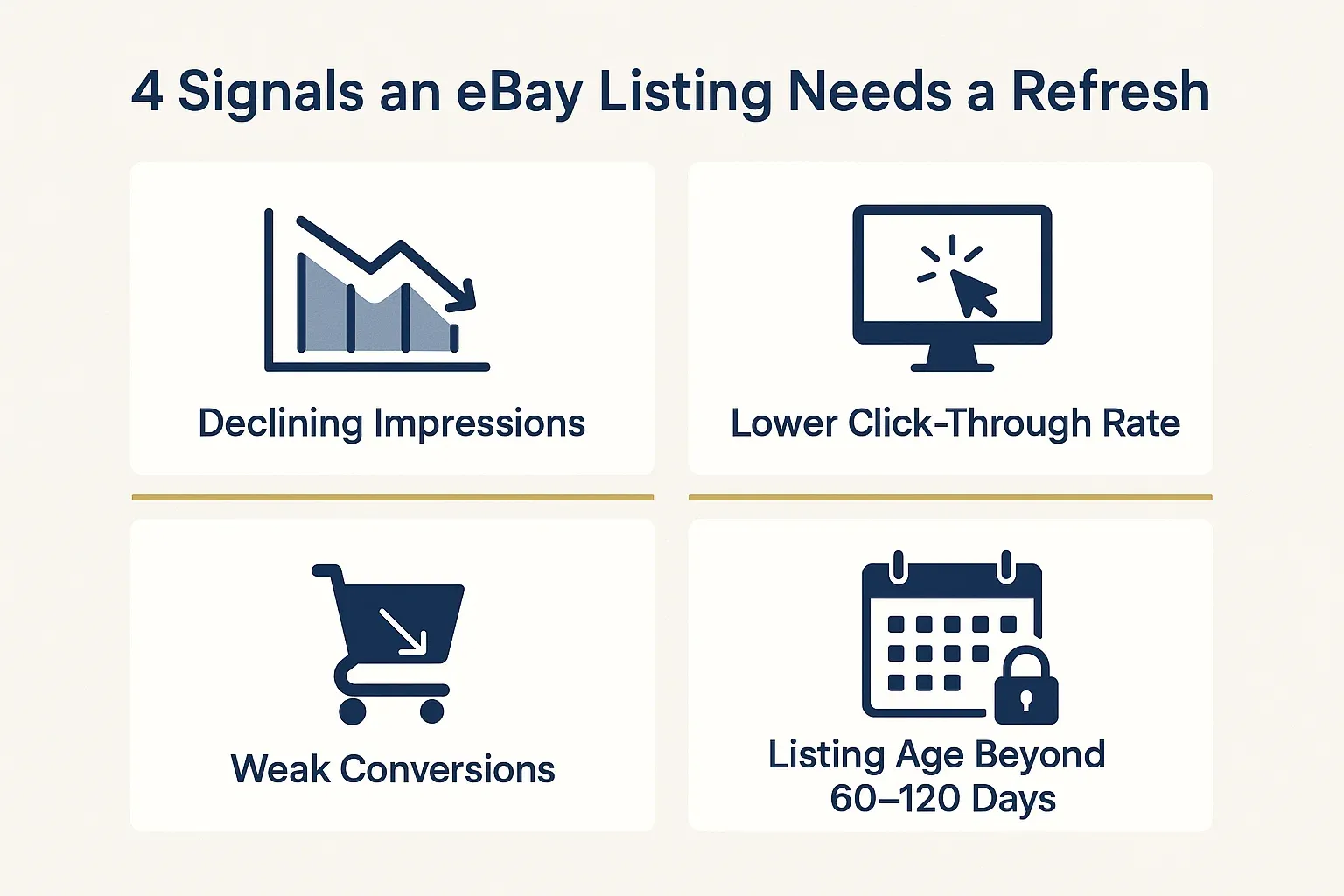
Every seller has experienced the frustration of a listing that once performed well but suddenly stops moving. It sits. It collects dust. Views decline. Impressions shrink. Eventually, it disappears from search results entirely. You lower the price, rewrite the description, or update the title, but nothing changes. This cycle has become one of the most common challenges for eBay sellers in 2025.
This problem has a name: listing fatigue.
And automation is the only reliable solution.
Listing fatigue occurs because eBay prioritizes listings that show ongoing activity. A listing created months ago without updates is treated like a stale webpage. The product can be perfect, the price fair, and the photos strong, but if the listing is old and unchanged, it falls down the search ladder.
Most sellers try the wrong solutions first. They edit a word in the title. They drop the price by fifty cents. They send offers to watchers. They tweak the subtitle or the item specifics. None of these actions actually refreshes a listing in a meaningful way. They create noise, not momentum.
The sellers who reversed the decline discovered a different path. They automated the refresh cycle. By using software that ends stale listings and relists them using Sell Similar, they reset listing age, update timestamps, and broadcast strong activity signals to eBay’s algorithm. The difference was massive.
A New Jersey jewelry seller described it perfectly: “My items didn’t suddenly become better. They just became visible again.”
To learn more about the exact listing cycles, refresh intervals, and how it helps sellers recover lost impressions, you may want to read Optimize Stale Listings on eBay: Proven Tips to Boost Visibility and Sales
Challenge #2: Pricing Pressure and the Margin Trap
Pricing is one of the most misunderstood elements of eBay selling. Too many sellers react emotionally to competitors. They see a lower price and immediately adjust. They get anxious when watchers do not buy and start discounting. They fear missing out on sales and slowly erode their profit margin with every tweak.
Here is the truth Top-Sellers learned:
Pricing is not a one-time decision.
Pricing is an activity signal.
Your price does not just impact your conversion rate. It impacts your visibility. Even small price adjustments show the algorithm that your listing is active, relevant, and being managed.
But manually adjusting prices daily or weekly is not sustainable. Sellers who tried to maintain this manually burned out quickly. Worse, some sellers used third-party repricers designed for Amazon or Walmart, not eBay. These repricers caused erratic price changes, created price races to the bottom, confused the visibility algorithm, and destroyed profit margins.
The real solution was dynamic price automation. Sellers who used automated price shifts saw stable margins and strong impressions because the automation kept listings active without destroying profitability.
One auto parts seller from Texas described it this way: “My items didn’t need lower prices. They needed movement.”
To understand more about how structured price updates can improve engagement, visibility, and overall profit, you may want to read Why Every eBay Seller Needs a Smart Pricing Tool
Challenge #3: Burnout, Overload, and the Limits of Manual Work
Every seller reaches a point where the work becomes overwhelming. You wake up to messages. You answer offers during breakfast. You print labels during lunch. You update inventory after dinner. Your entire day becomes a sequence of small tasks that block the strategic work that actually grows your store.
This burnout is not a lack of discipline. It is a workload problem.
Experienced sellers know this feeling well. They reach a point where they simply cannot add more hours to the day. They cannot relist manually, update prices manually, create listings manually, or answer every message personally. They hit a ceiling.
Automation breaks that ceiling.
By handing off repetitive tasks to systems instead of doing them manually, sellers reclaim hours and reduce stress. More importantly, they create a consistent rhythm of store activity that the algorithm rewards.
This is why automation is not a shortcut. It is a growth strategy.
To explore more on how message workflow improvements lead to better conversions and less daily stress, you may want to check Improve Customer Communication on eBay and Increase Your Sales
Misconceptions and Bad Solutions That Hold Sellers Back
Many sellers delay automation because they believe certain common misconceptions. These beliefs sound logical, but often backfire in the real world.
Here are a few examples:
Misconception 1: Editing a title refreshes the listing.
Reality: Title edits do not reset listing age or visibility.
Misconception 2: Lowering the price always increases sales.
Reality: It often reduces your margins without improving impressions.
Misconception 3: Sending mass offers boosts visibility.
Reality: Offer activity does not refresh stale listings.
Misconception 4: Competitor repricers help you win sales.
Reality: eBay is not a lowest-price marketplace. Visibility matters more.
Misconception 5: You need to respond to every message manually.
Reality: Automated message flows increase conversions and reduce workload.
These misunderstandings cause sellers to waste hours on actions that do not move the needle. Automation corrects these mistakes by letting data and rhythm drive decisions.
The New Automation Playbook for eBay Sellers in 2025
The biggest myth in the eBay world is that automation replaces YOU. In reality, automation frees YOU to do the things that actually matter: sourcing better inventory, creating stronger buyer trust, and refining strategy.
Automation is not about losing control. It is about removing resistance.
Here is how modern sellers built automated systems that grew their stores while reducing their daily workload.
Cavio AI: Creating Listings From Photos in Seconds
Creating listings manually has always been one of the slowest parts of eBay selling. Writing titles, drafting descriptions, choosing categories, filling in item specifics, setting prices, and organizing photos can easily take 10 to 15 minutes per item. For sellers with large inventories, this is not just inconvenient; it is a bottleneck.
Cavio AI changed the workflow entirely.
By uploading one or several photos, sellers receive:
- A complete, keyword-rich title
- A clean, accurate description
- Suggested pricing
- Auto-detected item specifics
- The right eBay category
- A professional structure for buyer trust
The impact is enormous. A seller who manually lists 10 items a day can suddenly list hundreds in less time. Instead of spending hours typing, sellers focus on photography quality, sourcing, and verifying details.
One example came from an auto parts seller in Ohio who described Cavio AI as “the moment my listing process finally caught up to the rest of my business.” His listing time dropped from seven minutes per item to under one minute, and his monthly output doubled without additional staff.

Automated Relisting and Sell Similar: The Visibility Engine
Every experienced seller eventually learns that stale listings are silent revenue killers. They sit too long. They lose impressions. They get buried. And once they fall, they rarely recover without intervention.
Automated relisting and Sell Similar became the foundation of every high-volume seller’s visibility strategy.
Here is how it works:
- The system identifies listings that are aging out
- It ends them
- It relists them as fresh listings
- It spreads activity throughout the day
- It sends consistent freshness signals to eBay
The difference between manual and automated relisting is night and day. Manual relisting is inconsistent because sellers run out of hours. Automation never does.
A Florida jewelry seller who implemented automated Sell Similar cycles saw impressions grow by more than 30% within 30 days. He described it as “the closest thing to turning the lights back on after sitting in the dark.”
Dynamic Pricing: Staying Competitive Without Losing Margin
The old approach to pricing was reactive. Sellers lowered prices whenever they felt visibility slipping. They guessed, hoping the algorithm would notice. They made emotional decisions based on competitors or watchers.
Automation replaced guesswork with predictable activity.
Dynamic pricing shifts prices at set intervals chosen by the seller. It creates the appearance of activity that eBay’s algorithm recognizes, without forcing sellers into a race to the bottom.
This tool helps sellers:
- Maintain consistent listing engagement
- Avoid unnecessary price drops
- Bring stale items back into rotation
- Manage inventory velocity
- Protect margins
One auto parts seller saw a close to 30% increase in impressions within four weeks of using dynamic pricing. He kept his profit margins intact while increasing visibility, proving that pricing activity, not pricing aggression, is what matters.
Automated Offers and Buyers’ Negotiation Workflows
Offers are a major source of sales, but they also drain time. When sellers respond slowly, buyers lose interest. When buyers send lowball offers, sellers waste minutes declining or countering. When watchers sit on listings for too long, potential sales evaporate.
Automated offer management solves this by allowing sellers to:
- Auto-accept offers within certain thresholds
- Auto counter based on percentage or dollar amount
- Auto decline lowball offers
- Send scheduled win-back offers
- Trigger discount messages for watchers
With these workflows, eBay stores run like well-oiled machines. Offers are processed instantly, 24 hours a day, without manual review.
One seller with more than three thousand listings described automated offers as “my second salesperson who never sleeps.”
Messaging Automation: The Quiet Engine Behind Higher Conversions
Messaging is one of the biggest time drains for eBay sellers, yet it has a direct impact on buyer confidence. Fast, consistent replies prevent confusion, reduce returns, and help close sales. Messaging automation handles repetitive tasks instantly, so buyers always receive clear, accurate information without delay.
Common automated flows include:
- Tracking and delivery updates that replace the generic eBay notifications buyers often ignore.
- Order confirmations that reassure buyers immediately after purchase.
- Condition-confirmation messages that clarify precisely what the buyer is receiving.
- Follow-up messages after answering a buyer’s question to gently remind them to complete the purchase if they were interested.
- Size verification for fit-dependent products, such as confirming ring size or clothing measurements before shipping.
- Year, make, and model verification for auto part sellers to prevent wrong-fit returns.
There is a big difference between eBay’s default “Your item is on the way” notification and a personalized update from the seller. A $5 item does not need a custom message, but automated systems like MyListerHub do not get tired. They send timely, consistent, seller-branded messages that build trust, boost conversions, and reduce issues without adding work to your day.
Inventory Sync: Eliminating Overselling and Manual Updates
Overselling may sound like a minor inconvenience, but advanced sellers know it can damage a business for weeks. Canceling orders leads to negative metrics. Repeated cancellations lead to category restrictions. Buyers lose confidence. eBay penalizes sellers who repeatedly cannot fulfill orders.
Inventory sync prevents all of this.
Whenever sellers receive an order, their inventory automatically updates. Whenever they restock, it updates again. Whenever they end listings, stock levels adjust. Nothing needs to be tracked manually.
This is especially important for sellers managing:
- Multiple warehouses
- Large SKU counts
- High-velocity items
- Refurbished or open-box stock
- Return restocking
- Daily bulk listing cycles
With inventory sync, the system simply never forgets.
Smart Shipping Labels: Faster Fulfillment, Fewer Mistakes
Shipping is one of the most repetitive operations in an eBay business. Sellers click, print, package, scan, and repeat the cycle endlessly.
Smart shipping labels automate the repetitive steps by:
- Suggesting the lowest-cost carrier
- Auto-filling package dimensions and weight
- Storing presets for common box sizes
- Auto-pulling buyer addresses
- Syncing tracking back to eBay
- Verifying shipping address
This not only saves time, but it also reduces errors. Every seller knows the pain of entering the wrong ZIP code or forgetting to upload tracking. Automation eliminates those headaches.
Feedback Automation: Building Seller Reputation at Scale
Feedback is one of the greatest conversion signals on eBay. High feedback counts build trust. Low counts and slow responses create hesitation.
The challenge is that collecting feedback manually is nearly impossible. Buyers rarely remember to leave feedback without prompts.
Feedback automation closes the loop by:
- Sending gentle reminders
- Explaining the value of feedback
- Highlighting seller effort
- Encouraging positive engagement
Sellers reported that their feedback counts grew significantly faster once they automated the process. This increased buyer trust, which ultimately raised conversion rates.
Data-Driven Decision Making: The New Skill Every Seller Needs
For years, most sellers operated on instinct. They lowered prices when they felt sales were slow. They refreshed listings when they remembered. They rewrote descriptions when they were bored. They acted based on feel, not facts.
Advanced sellers now use data to guide their decisions.
By tracking:
- Impressions
- Click-through rate (CTR)
- Conversion rate
- Listing age
- Price history
- Inventory velocity
- Message volume
- Offer patterns
They learned to identify exactly why a listing performs or stalls.
Data replaced emotion.
Strategy replaced guessing.
Automation became the execution engine.

The Road Ahead: Why Automation Will Define eBay Success in 2025
As eBay becomes more structured, more competitive, and more algorithm-driven, sellers who operate manually will struggle to keep up.
The sellers who scale will be the ones who:
- Automate repetitive work
- Refresh listings consistently
- Embrace AI listing creation
- Maintain steady pricing activity
- Strengthen buyer trust
- Use analytics to guide strategy
- Simplify fulfillment
- Build systems that run without constant supervision
Manual selling was possible years ago.
It is not sustainable now.
Automation is no longer an optional upgrade. It is a requirement for staying competitive.
Common Questions Sellers Ask:
How can I automatically create a listings cycle to boost visibility on eBay?
You can automate listing refresh cycles by using tools that detect stale listings, end them, and relist them with Sell Similar. This resets listing age, updates activity signals, and improves visibility in eBay search results. Sellers who automate this process see stronger impressions, better click-through rates, and more consistent sales because the algorithm prioritizes active, recently refreshed inventory.
What automation tools actually help eBay sellers save time and increase sales?
The most impactful automation tools are AI listing generators, automated Sell Similar cycles, dynamic pricing that adjusts at set intervals, automated offers, messaging automation, and inventory sync. These systems eliminate repetitive work, improve listing freshness, and increase conversions by keeping your store active and responsive without constant manual input.
Do sellers still need to monitor listings manually after setting up automation?
Automation significantly reduces the daily workload, but sellers still benefit from reviewing overall performance data. Metrics like impressions, CTR, and conversion rates help determine when listings need better images, stronger titles, or updated descriptions. Automation handles execution, and analytics help sellers guide strategy.

by Omri Ross